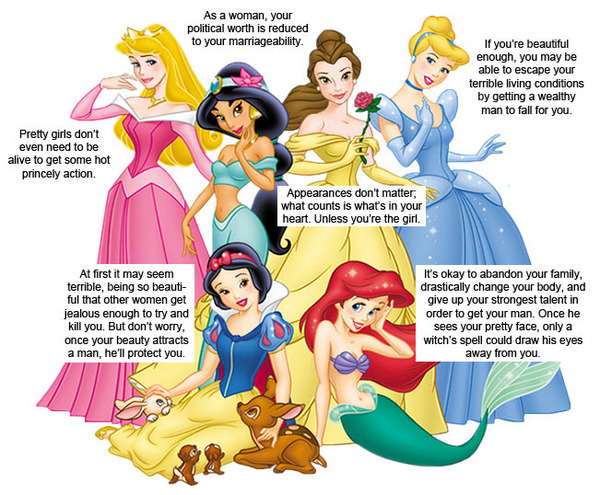

I can admit, I was raised on Disney. And while I might not have intentionally thought about the messages it sent me, I can certainly agree that I wasn't exactly being empowered by them. And taking a look through the text on those images, it's a bit undeniable that princesses aren't exactly teaching our girls to be strong, independent women.
I've been thinking about two other messages princess culture sends girls: stereotypical femininity is best and passivity.
- Stereotypical femininity: Now, I have no problem with general girliness, but I can't get behind a world which encourages only one kind of girlhood to our young woman. It's just too gender binary--what about the girls who want to play in the dirt and drive cars? Or who just don't like wearing dresses? And PLEASE don't give me the "Mulan" excuse...she didn't get to succeed as a strong female, she had to BE a man to be seen as legit. And when all was said and done, her ultimate prize was ending up back at home with a dude.
- Secondly, it really, really bothers me how the overwhelming characteristic of the princesses is their passivity. Not only are they frequently lost to the whim of villains (who are often evil women, you can tell they're evil because they have dark hair, or they're fat or ugly) and men in the stories, but their very claim to fame/identity (their princessness) is something that they were granted at birth. Not something they fought/worked for or earned.
And if you think that girls aren't affected by the princess stuff, I give you an anecdote. I was doing an economic literacy program with 6-8 year olds at the nonprofit I worked for in Indy a few years ago and we were discussing future career goals. One little girl asserted that she wanted to be a princess when she grew up. Sigh. My heart was a little bit broken in that minute and I couldn't help but feel that our society had done this little girl a REAL disservice. She quite literally believed that "princess" was a viable future career aspiration. I tried to work through the implausibility of that with her, but I'm not sure I made much headway. (Fortunately, the rest of the girls chose things a little more realistic.)
I know the inclination now is to say, "Aww, how cute. She just doesn't know what she said" and to chalk it up to her being so little. But the truth is I bet you'd be hard pressed to find a boy her same age who would choose something that illogical as his career goal. He might say something difficult to achieve (like astronaut) but not a career straight out of a fairy tale. Life just isn't teaching boys that their role is to be pretty and married.
Anyway, the princessness of everything really grates on my nerves. I'm sure that this means that someday I am bound to have a daughter who eats and breathes pink, pretty, fluffy, butterfly-y things, much like what happened to strong, independent Julia with her daughter Sydney (in one of my favorite shows, Parenthood) last Halloween. However, much like Sydney, my hypothetical future daughter would have a home life which defied stereotypical gender roles and has outright discussions about gender, which is the environment I wish more kids encountered. In other words, I love this girl's parents:

I see what you're saying here.
ReplyDeleteAlthough, I think some of those narratives in the photos your provided are a little overdramatic and twisting of the storyline, but he main thing that has always bothered me about the Disney princesses is that the stories and their lives seem to be surrounded by love and men. It's rarely about pursing a dream that has nothing to do with finding love. And also, the "happily ever after" idea has always been unrealistic, as if no one ever has any problems after they find love. They never show how tough a relationship or marriage can be.
I haven't yet seen "Tangled," but I've heard it gets *slightly* closer to being feminist, because Rapunzel is smart, driven by her own curiosity and desires, and saves the male character on more than one occasion. I've heard it still relies on some of the themes you mentioned, like the old woman as the villain and the fact that it all ends with a happily-ever-after love story. I'm pretty excited about Disney/Pixar's "Brave" though! From what I've gleaned from the trailer, it's about a tomboyish (she shoots arrows, rides horses) princess who rejects her family's attempts to force her into an arranged marriage and sets out to change her destiny. Let's hope they get it right this time.
ReplyDeletePS- Although is probably doesn't count as a princess movie, I loved the portrayal of Alice in "Alice in Wonderland". She's probably the smartest and strongest female character to ever come out of a Disney movie.
Brave will be the next I review for my tour of gender in the 2012 blockbusters :)
DeleteI'm glad I came across this. :)
ReplyDeleteMe being a 17 year old feminist, who began objecting to a lot of misogynistic notions while growing up, this issue was certainly one of them.
I'm pretty sure I'm the only one in my school who has such strong views on feminism and misogyny.
Fairytales play the dual role of not only setting standards for girls and making their princesses stick up to conventional good girly looks and a certain kind of femininity, but also portray strong and authoritative women as a threat. (Read: the Evil Queen in Snow White).
On a little wider note, I'm so disappointed that feminism as a concept is looked down on so negatively, particularly by men, that even women shy away from accepting that they are feminists. It kinda defeats the whole purpose of the female movement.
"Oh, a feminist must be this stingy woman who would end up all alone!"
And then there's slut shaming and girls hating on each other. Because that's what girls do. Bitch about other girls because we are that trivial!
But anyway, I won't digress and get straight to the point. I'm glad I read this post and came to know of this blog. I guess I'll just scroll through more posts now. :)
Hi! Welcome! I'm always a little jealous of people who arrive at feminism at your age and younger. I could have saved myself a lot of trouble if I had thought critically about life much sooner :)
Delete